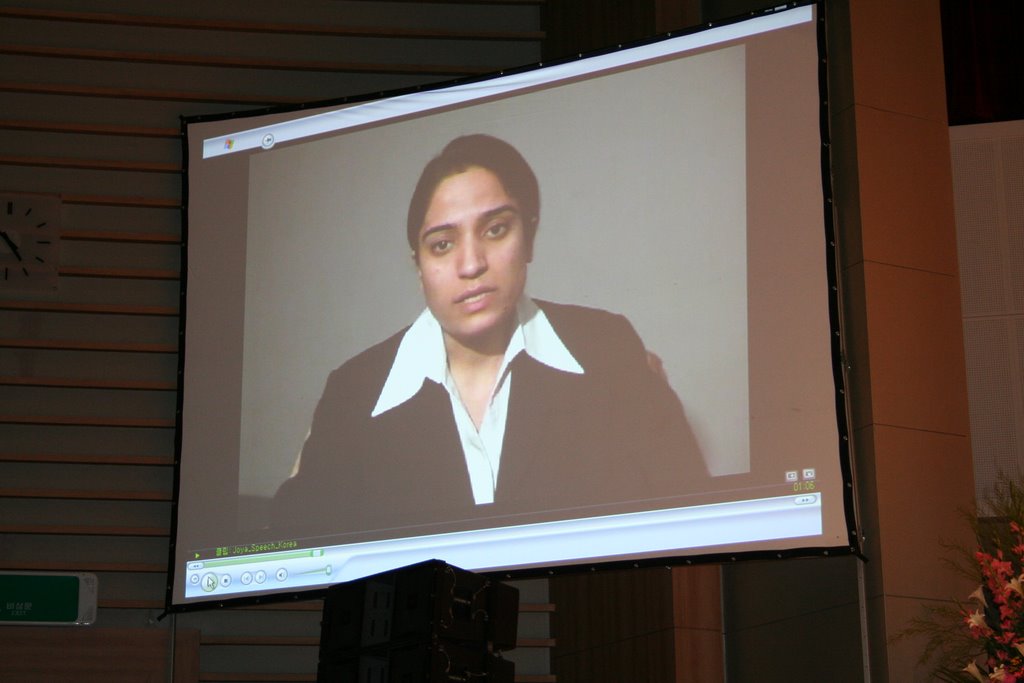
We would like to share this vlog made by Amnesty International as a way to encourage you to sign up for those petitions: email and post card campaign we are doing for Ms. Malalai Joya (Afghanistan) and Ms. Irom Sharmila (Manipur, India) both are winners of Gwangju Prize for Human Rights Award 2006 and 2007 respectively.
We hope that you appreciate and recognize that life is at stake when freedom, justice, human rights, democracy and peace is trampled upon.
Take few moments to savor the message of this vlog:

Thursday, July 12, 2007


Wednesday, July 11, 2007
Email Campaign for Malalai Joya

Reinstate Malalai Joya!
“The Afghan Parliament is worse than an animal stable whose many members are the murderers and enemies of Afghan people,” was a comment made by Malalai Joya in an interview that got the ire of the members of the parliament, prompting her unjust ouster.
Joya criticized the parliament for their failure to legislate laws that benefit the Afghan people. Instead they passed bills like the “Amnesty Bill” that pardons and condones the misdeeds of human rights violators, corrupt officials, drug smugglers and other criminals, as well as creating parliamentary procedures that restrict the freedom of speech.
Malalai Joya is a well known women’s rights advocate who have won several international awards for her work and advocacy among them the 2006 Gwangju Prize for Human Rights Award given by the May 18 Memorial Foundation of the Republic of Korea.
Malalai Joya is in constant danger; she has survived several assassination attempts and remains under threat. But these will not frighten her to continue promoting and defending women and children’s rights and fighting for reforms with the Afghan people against corruption, fundamentalists’ abuses, warlords and drug smugglers.
We call on the Afghan Parliament to respect the voice of its people for electing Malalai Joya! We call for international solidarity to Afghan people’s call for justice and democracy!
Afghanistan deserves a true and dedicated Parliamentarian
Reinstate Malalai Joya !
Reinstate Malalai Joya !
Send this email to the following:
President Hamid Karzai
khaleeq.ahmad@gmail.com
president@afghanistangov.org
Supreme Court of Afghanistan
aquddus@supremecourt.gov.af
Afghanistan's Parliament
hasib_n786@yahoo.com
Interior Ministry
moinews@gmail.com
wahed.moi@gmail.com
Justice Ministry of Afghanistan
info@moj.gov.af
hidayatr@moj.gov.af
Check this site to send the Afghan Ambassador of your country
http://www.mfa.gov.af/foreignmission.asp
Forward a copy of your email to
mj@malalaijoya.com
518campaigns@gmail.com
For more information check these sites:
http://www.malalaijoya.com/index1024.htm
http://en.wikipedia.org/wiki/Malalai_Joya
http://eng.518.org/english.html
Wednesday, July 04, 2007
518 Launches Campaign for Ms. Irom Sharmila

Repeal The Armed Forces Special Powers Act, 1958 (AFSPA)! Release Irom Sharmila! These were unanimous calls among the participants of the Gwangju International Peace Forum and East Asia Human Rights Forum 2007 held this May in Gwangju City, Republic of Korea.
Ms. Irom Sharmila is being held under judicial custody for her campaign for the repeal of the AFSPA with her fast-to-death advocacy for more than 6 years now. For this, The May 18 Memorial Foundation's 2007 Gwangju Prize for Human Rights Committee have awarded Ms. Irom Sharmila together with Dr. Lenin Raguvanshi the 2007 Gwangju Prize for Human Rights.
The committee acknowledges Ms. Sharmila's non-violent advocacy in the repeal of a draconian law that continues to oppress the citizens of Manipur. Ms. Irom Sharmila is given recognition and honor for her indefatigable efforts to improve human rights in India and the noble cause of social justice. Her example is an inspiration to the many people throughout the world who are striving to attain democracy, human rights and peace.
"A letter was sent to the Indian government to allow Ms. Irom Sharmila to receive her prize but it was ignored" said Mr. Chanho Kim, Director of the International Cooperation Team. As a show of continuing support to Ms. Sharmila's advocacy The May 18 Memorial Foundation is launching a post card campaign to create more pressure to Indian authorities and encourage solidarity among nations to stand-up against oppressive laws like AFSPA.
The post card calling for the Release of Ms. Irom Sharmila and the Repeal of AFSPA will be distributed to The May 18 Memorial Foundation networks both domestic and abroad. The post card can be sent individually to the Indian Embassy of any country or it could be sent to the coordinating organization of a particular place who will then send those collected post cards to the May 18 Memorial Foundation.
The public is encouraged to email us at 518campaigns@gmail.com for queries or visit the English website of The May 18 at www.518.org for other information and details.
Please fill out the attached petition-post card and email to the following:
1. Dr. A.P.J. Abdul Kalam
President of India
President's Secretriat, New Delhi
INDIA.
Tel: +91 11 23015321
Fax: 91-11-23017290 & 91-11-23017824
E-mail: presidentofindia@rb.nic.in
2. Mr. Manmohan Singh
Prime Minister of India
Prime Minister's Office
Room number 152, South Block
New Delhi
INDIA
Fax: +91 11 23016857
Email: pmosb@pmo.nic.in
3. The Chairperson
National Human Rights Commission of India
Faridkot House, Copernicus Marg
New Delhi 110001
INDIA
Fax: +91 11 23384863
Email: chairnhrc@nic.in
4. Hon. Shivraj Patil
Ministry of Home Affairs,
Secretariat, New Delhi - 110 001
Phone: 23092462/23017256
Fax:23794842, 23793716
23794833(fax)
Email:websitemhaweb@nic.in
6. Foreign Missions (Check the contact details of the Indian Embassy in your country through this site) :
http://goidirectory.gov.in/missions.html
Officials of Manipur to send your Email
A) Ministers and MLAs of Government of Manipur
1. Shri Ved Marwah, His Excellency Governor of Manipur govmani@hub.nic.in
2. Shri O. Ibobi Singh, Chief Minister, Manipur cmmani@hub.nic.in
3. Speaker, Manipur Legislative Assembly man-speaker@hub.nic.in
4. Shri K Govindas govindas@hub.nic.in
5. Shri Phunzathang Tonsing, Minister (Power), Manipur manipower@hub.nic.in
6. Shri Th. Debendra Singh, Minister (Industries) debendra@hub.nic.in
7. Shri W. Keishing, MOS ( Fisheries & Govt. Press) wkeishing@hub.nic.in
8. Advocate General, Manipur ag-manipur@hub.nic.in
B) IAS and MCS Officers of Government of Manipur
1. Chief Secretary, Manipur csecmani@hub.nic.in
2. A R Khan, IAS,Commissioner(S&T) arkhan@hub.nic.in
3. B B Sharma,IAS man-bbs@hub.nic.in
4. Ch Birendra Singh, IAS birendra@hub.nic.in
5. D S Poonia, IAS dspoonia@hub.nic.in
6. Dev Shekhar Sharma, IAS devsharma@hub.nic.in
7. Gyan Prakash, Jt CEO gyan@hub.nic.in
8. Henry K Heni, IAS henry@hub.nic.in
9. Jason A Shimray, Jt Secy jashimray@hub.nic.in
10. L Gangte, IAS lgangte@hub.nic.in
11. L P Gonmei, IAS lpgonmei@hub.nic.in
12. M Lakshmi Kumar, Jt Secy mlkumar@hub.nic.in
13. Md Sajjad Hasan shasan@hub.nic.in
14. O Nabakishore, IAS oinam@hub.nic.in
15. P Bhorot Singh, IAS pbhorot@hub.nic.in
16. P Kipgen, IAS pkipgen@hub.nic.in
17. P Sharat Chandra, IAS pschandra@hub.nic.in
18. R K Nimai Singh, IAS rknimai@hub.nic.in
19. Raikhan Chhibber, IAS rchhibber@hub.nic.in
20. Rajesh Kumar, IAS rjkumar@hub.nic.in
21. RK Angousana Singh, IAS angousana@hub.nic.in
22. S Budha Chandra, IAS budha@hub.nic.in
23. S Jerol, IAS jerol@hub.nic.in
24. S Kunjabihari Singh, IAS kunjabihari@hub.nic.in
25. S Sunderlal, IAS sunderlal@hub.nic.in
26. Saichhuana, IAS saichhuana@hub.nic.in
27. Secretary to Governor, Manipur man-secygov@hub.nic.in
28. Shambhu Singh, IAS man-shambu@hub.nic.in
29. V Chhibber, IAS vchhibber@hub.nic.in
30. V K Thakral, IAS vkthakral@hub.nic.in
C) Departments and other Officers under the Government of Manipur
1. 17th Assam Rifles, Imphal ar17bn@hub.nic.in
2. ADC to Governor, Manipur adc-gov@hub.nic.in
3. AIR, Imphal airimphal@hub.nic.in
4. Board Of Sec. Education, Imphal bsem@hub.nic.in
5. BRTF, Imphal brtf-imphal@hub.nic.in
6. Dept. of Science, and Technology, Imphal dstmanipur@hub.nic.in
7. Deputy Comdt, 33bn BSF, Bishnupur bsf33bn@hub.nic.in
8. Deputy Director, Manipur State Archives, Imphal man-archives@hub.nic.in
9. DGP, Manipur dgp-mnp@hub.nic.in
10. DIG, Police Department, Imphal dig-ops@hub.nic.in
11. Director, Education(S), Imphal diredus@hub.nic.in
12. Director, Information and, Public Relation, Imphal man-dipr@hub.nic.in
13. Director, Minorities and Other Backward Classes, Imphal mobc@hub.nic.in
14. Director, Planning, Imphal dirplg@hub.nic.in
15. Director, Youth Affairs and Sports, Imphal dir-yas@hub.nic.in
16. Doordarshan Kendra, Imphal ddk-imp@hub.nic.in
17. Gauhati High Court, Imphal ghc-imp@hub.nic.in
18. Govt College of Technology, Imphal gct-imphal@hub.nic.in
19. IGP Intelligence igp-int@hub.nic.in
20. J B Negi, IPS jbnegi@hub.nic.in
21. MASTEC, Imphal mastec@hub.nic.in
22. Police wireless, Imphal man-wire@hub.nic.in
23. R Baral, IGP rbaral@hub.nic.in
24. SP, CID (SB), Imphal cid-sb@hub.nic.in
25. T Thanguthuam, IPS thanguthuam@hub.nic.in
26. Kh. Rajen Singh, PSA & SIO sio-man@nic.in
rajen@nic.in

(Note - a word file of this post card is available at 518 website.)
Related link about this issue:
1)Women give vent to naked fury in front of 17 AR at Kangla http://images.google.co.in/imgres?imgurl=http://www.e-pao.net/galleries/images/ManoramaKillingJuly2004/Jul15women_protesting_nude2.jpg&imgrefurl=http://www.e-pao.net/GP.asp%3Fsrc%3D1.10.160704.jul04&h=450&w=600&sz=39&hl=en&start=1&tbnid=wvWYGHE3j8WnHM:&tbnh=101&tbnw=135&prev=/images%3Fq%3D15%2Bjuly%2B%252B%2BManipur%26gbv%3D2%26svnum%3D10%26hl%3Den
2) MANIPUR ON FIRE http://images.google.co.in/imgres?imgurl=http://www.hinduonnet.com/fline/fl2118/images/20040910007400404.jpg&imgrefurl=http://www.hinduonnet.com/fline/fl2118/stories/20040910007400400.htm&h=340&w=350&sz=37&hl=en&start=41&tbnid=oX16MHs8GQG6cM:&tbnh=117&tbnw=120&prev=/images%3Fq%3Dnude%2Bprotest%2B%252B%2BArmed%2BForces%2BSpecial%2BPowers%2BAct%2B%26start%3D40%26gbv%3D2%26ndsp%3D20%26svnum%3D10%26hl%3Den%26sa%3DN
Final Call for Applications!

Have you sent in your application for the Gwangju Asian Human Rights Folk School 2007?
The dateline is just around the corner and the competition is tough…..
Greetings!
The Gwangju Asian Human Rights Folk School aims to contribute to the development of democracy and human rights throughout Asia. Total of twenty-five (25) invitees from all over Asia who have been working for human rights and peace organizations in their own countries shall be given an opportunity to learn and experience the history and development process of human rights and democracy in South Korea.
Participants will be introduced to Korean history, the movements and struggle for democracy, including the 1980 Gwangju Democratic Uprising, both through theoretical and practical experiences such as seminars, discussions and field trips to the sites of democratization movements in Korea. Included in the program design are sessions on administration of cultural events and youth activities; orientation on documentation and record preservation; and building networks and conduct of international cooperation projects.
Basic Criteria
1) Applicants will be chosen and categorized according to the following levels:
a) 5 participants – Senior Manager/Director Level (Total of 3-week of stay in Korea)
b) 10 participants – Middle Manager/Supervisory Level (Total of 2-week of stay in Korea)
c) 10 participants – Junior Staff (Total of 2-week of stay in Korea)
2) Must have more than 2 years of NGO work experience (human rights, democracy and/or peace organizations) for the junior staff. The other levels require minimum 5 years of work experience.
3) Facilities for English language (Korean an advantage) and demonstrate capacity for active participation in discussions and cultural events.
4) Application is endorsed by his/her organization.
5) Must be sensitive to cultural conditions and traditions of Korea/Koreans and co-participants.
Application and Selection Process of the Gwangju Asian Human Rights Folk School
1. Application forms will be released in June 2007 and the deadline for applications will be on 20th July 2007. The final list of folk school participants will be announced in the month of August 2007.
2. The folk school will be conducted for two weeks from September 2-16, 2007.
3. Applicants should fill-out the application form properly and submit via email to The May 18 Memorial Foundation.
4. The May 18 Memorial Foundation - International Committee, (composed of individuals from different organizations) is in-charge of selecting the final list of participants after a careful evaluation and assessment of applicants.
5. Guidelines and other details on the Gwangju Asian Human Rights Folk School will be given to successful applicants.
Important Dates:
1. Application deadline: July 20, 2007
2. Period of event: September 2-16, 2006
Other Information and Details
The May 18 Memorial Foundation will cover round-trip airfare, meals, and accommodation of those successful applicants.
Please download and fill out the application form found at the 518 website and email it to us at: 518folkschool@gmail.com
For information about the past folk schools visit our blog and check the September 2005 archive at - 518folkschool.blogspot.com.
To learn more about the The May 18 Memorial Foundation please visit the English section of our website at – www.518.org
Please help us disseminate this information.
Good wishes.
Chanho Kim
Director
International Cooperation Team
The May 18 Memorial Foundation
Updating our directory

Warm greetings !
We are currently in the midst of updating our database. As such, we hope that you will be able to help us identify the active and inactive e-mail addresses.
If you get this mail, please do send us a mail in reply, identifying yourself. Please include information like:
Name
Position
Organization
Field of work
Mailing Address
E-mail Address
Web/Blogsites
Phone number/s
Fax number
Other relevant contact details.
Thank you for taking the time out of your busy schedules to update us. Please email us at 518org@gmail.com
We really appreciate it.
Have a nice day.
Warm Regards,
International Cooperation Team
Tuesday, June 05, 2007
'We are May 18'

by
Amit Sengupta
Gwangju (Republic of Korea)
The May 18, 1980 Gwangju uprising against military dictatorship is a reminder that history is still incomplete
There is a chill in the air and the flowers are blooming in orange, blue and vermilion-yellow on the beautiful, stunningly clean, pebbled, rain-washed, sunshine streets of Gwangju, the epical landmark of the great democratic uprising against military dictatorship in 1980. The city is celebrating, even as young couples walk through the inner lanes holding hands. There are banners everywhere, anticipations, tragic memories; there is the will to hope, to create new rainbows of democracy, justice and freedom.
There are old 'war-zone' landmarks, the sacred places of the dead, the missing and the murdered, the spontaneous students' protests at the Chonnam National University, the 'civilian army's' combat with the armed forces at the legendary Provincial City Hall which was captured by the people. May 18 is in the air. The Koreans call it simply: 5.18.
In down town Gwangju students are preparing for massive demonstrations, carnivals and traditional/revolutionary cultural shows. The market is overwhelmed with young people, girls and couples, schoolgirls in uniform, while food stalls in handcarts are happy with the crowds. At the Kenya Espresso coffee shop, a young history teacher sipping coffee with her school students, sums it up: "I am proud of the May 18 uprising. I was 12-year-old then, but I know that this change was necessary. Not much is mentioned in the textbooks, but I show videos, keep the memory alive," says Kim Young Sin. Her student is not shy. "When I see the images of the massacre, tears flow down my eyes," she says.

The May 18 Memorial Foundation is celebrating the 27th anniversary of the uprising, and the city is proud of it. Gwangju stands in world history as a city which knows how to preserve its precious memories and respect it, because the inhabitants are deeply aware that those, who inherit the fruits of democracy and then choose to forget the sacrifices of their rebels, are fated to be condemned. "South Korea is indebted to Gwangju," says journalist Moon Tae Jeong.
That is why two Indians have been awarded the prestigious $50,000 Gwangju Prize for Human Rights this year: Irom Sharmila of Manipur, for her six-year-long fast against the repressive Armed Forces Special Powers Act, 1985; and Lenin Raghuvanshi of UP, for fighting child and bonded labour and untouchability in the Hindi heartland. Ironically, the organisers said, the Indian government refused to respond.

The Foundation building in the heart of the city is a sacred space. There are 135 delegates in the East Asia peace forum shaking hands, feminists, journalists and human rights activists from Philippines, Cambodia, Vietnam, Burma (exiled pro-democracy freedom fighters), Indonesia, Thailand, Malaysia, India, Bangladesh, Japan. Predictably, none from China or North Korea.
"We want a new Asian solidarity, a new vision for human rights in South Korea and Asia," said Foundation Chairman Honggil Rhee. He was a 39-year-old history professor in 1980 who fully backed the movement and was suspended and jailed. "Korean people believed that military dictatorship under Chun-Doo-Hwan is not acceptable. Students and professors joined the struggle of the citizens. The killings started. They thought they could crush the movement for democracy and set an example. It back-fired because of the people's resilience. We learnt many things from the rising. We have to constantly fight to get and retain democracy. These were the highest form of sacrifices and we just can't afford to forget that," he said.

During and after the democratic and peaceful uprising and the massacre that followed, the people took up arms. A civilian army was formed with students, teachers, workers, farmers, doctors, daughters and mothers. The Provincial City Hall was liberated as a symbol and the city too was liberated. People spilled onto the streets to create support systems. Weapons were looted. Food supply was restored, cooking often on the streets. The locals looked after the injured. The dead were buried.

The city's memories are full of dark anecdotes. There were stories that the clampdown was US-backed because the military dictatorship was supported by the US. The city was isolated and under siege. No news was allowed to filter out. The rest of the world, from May 18 to May 27, 1980, was blocked out, and even much later, for months. Rumours were circulated by the dictatorship that the uprising was inspired by anarchists and communists led by North Korea, which proved to be an utter lie, because it started as a spontaneous and peaceful rebellion of ordinary citizens, disgusted and angry with the atrocities of military rule.

A taxi driver saw the killings. A priest from a nearby province discovered the bloody stories. A shoeshine boy was a witness, and later, a fighter. The stories started floating out. Some people arrived from Seoul to find the city "as usual", with not a flutter—so entrenched was the terror. Then the rebellion started spreading with word and text, the dirty official rumours began to sound dirty, protests moved in a spiral from villages to towns and cities, especially among the strong Leftist, anti-imperialist students' movement in Seoul. But it still took a while, almost a decade and more, for the military dictatorship to dismantle its ugly scaffoldings.

The official death count of the Gwangju massacre is 207. The unofficial runs in the 2,000 plus figure. There are many who have still not been identified. Many students died fighting. The missing have gone missing. Many fell to their injuries, many were tortured, many became insane, some committed suicide. All stories remain categorical yet ambiguous, moving from lips to lips, eyes to eyes, fingers to fingers, flowers to flowers.
But the spirit and the soul of the great rebellion remains. At the sublimely aesthetic National May 18 Democratic Cemetery, an hour from Gwangju, where the entire city, political establishment, students, Buddhist monks, mothers and relatives of the fighters, remember the martyrs with a series of prayer meetings and traditional Korean songs. Tears flow easily. On the mud and grass graves, they put food and Soju, the local drink. A girl student kneels and touches a grave: she has read about it, she wants to feel it herself.

A young Korean volunteer tells us that there are 481 graves, there are more 'spaces' for those yet to be discovered, "We are still looking for dead bodies." Next to every grave, there are vases of flowers, neatly arranged, a message and name on the little monument, and a framed photograph of the rebel: girls, boys, elders, and workers. Those whose pictures can't be found, or who can't be identified, have a framed flower instead of a face: Mugunghwa, the serene national flower of South Korea, with its unique aroma.
The aroma spreads. In down town Gwanju outside the epic landmark of the City Hall, thousands are marching, screaming, shouting pro-unification (with North Korea), pro-democracy and anti-Bush slogans, grandmothers with drums, masked students with branches of the trees, girls with paper lamps, workers and activists with torch-lights, with massive music in the background. Thousands are holding hands and singing. All the delegates of the May 18 peace forum are jumping, hugging and clapping. They are all singing, laughing, shouting slogans, some with tears in their eyes. "We are May 18," says a poster in a students' hand. "Chun-Doo-Hwan, go do harakiri," shouts the woman leader on the loud-speaker. They hate Chun-Doo-Hwan. Thousands repeat this angry slogan. Again and again.
At the entrance of the sunshine cemetary, there are two banners, which sum it up, simply: History is Never Complete, May 18 Uprising is Continuing… It is not Finished.
Yes, because 'We are May 18'.

Thursday, May 31, 2007
AFAD Statement for the International Week of the Disappeared

From May 26 to June 1, the International Week of the Disappeared, we remember all the desaparecidos whose lives have been erased yet whose memories even legacies continue to live on in our hearts. Our memory of them has served as sparks of fire that kindled the fire in our spirits to march to the streets calling their names and demanding that they be surfaced alive and be returned to their families alive! We stand together with all the pained families, our hopes undaunted by this long-drawn struggle against impunity. With them, we patiently await the day when missed fathers, brothers, sons, mother, sisters and daughters, would finally come home.
Disappearances cause adverse impacts in the lives of the families of the victims. Trauma for one thing is the hardest to overcome. Since 2004, AFAD has been conducting rehabilitation sessions for the families of the disappeared. In one of the sessions, a symbolic re-planting of a couple of plants was done. These plants were uprooted, thus, they must be brought back to the earth soon, or they would wither and die. It signified how involuntary disappearances have uprooted families from their normal lives and the routines they used to have. If their broken hopes and dreams are not "re-planted" soon, they too will lose the will to live and be lost in an endless tide of despair.
Thus, in AFAD's effort to bring truth and justice to these families, it hopes to re-plant the families lives, bring them closure and stability. On this International Week of the Disappeared, AFAD not only expresses but emphasizes its aim to help revive the strength and the will to live amongst all the families.
On June 1, the Federation has arranged a tree-planting activity to put into tangible symbols all these hopes for a renewed life, spirit, hopes and dreams. All member-organizations will plant and hold their symbolic tree for all the desaparecidos around the world. And soon, as these seedlings find their roots once more on the solid earth, the families too will find their roots again in society. And over time, as the seedlings grow, let us hope that so will the hopes and dreams of the families. And as the seedlings soon become steady and strong trees that can weather any storm, so will the lives of the families.
But of course, these seedlings cannot grow into strong trees without our care and nurturing. Hopes, dreams and lives cannot survive without love and support from relatives and friends. So on this special week; let us renew our commitment to care for our missed loved ones, our families and friends. Together, let us all grow strong and sturdy to weather any storm.
The Asian Federation Against Involuntary Disappearances considers the International Convention on the Protection of All Persons from Enforced or Involuntary Disappearances as a major source of strength. On the occasion of the International Week of the Disappeared, we call on all governments, especially Asian governments to sign and ratify this important international treaty that ensures the protection of all persons from enforced disappearances. Its implementation in the national level would require the enactment of national laws criminalizing enforced disappearances which do not yet exist in any part of Asia.
Signed:
MUGIYANTO
Chairperson
MARY AILEEN D. BACALSO
Secretary-General
Tuesday, May 29, 2007
Gwangju International Peace Forum (GIPF) 2007

Gwangju International Peace Forum (GIPF) 2007
Draft Agreement / Decisions
17 May 2007
Inspired by the spirit of Gwangju which symbolizes people’s struggles and resistance against state violence and self-governance as demonstrated in May 1980,
Alarmed by the worsening human rights situations and sliding back of democracy in many countries in Asia,
Compelled by the urgent need to respond to the challenges of ‘threat to democracy’ and dominant culture of impunity,
1. We, participants of the GIPF 2007, resolve to initiate a foundational process of establishing a regional network (forum, platform, corridor, etc.) for action among democracy advocates, human rights defenders and social movement activists, mainly participants of the GIPF since 2003 based on the collective experiences of struggle for democracy and human rights and sense of solidarity created among participants of 1st East HRD Forum 2007.
2. A network to be created can be called temporarily “International Movement for Democratization in Asia” (IMDA).
3. Its main purpose is to promote regional cooperation among democracy advocates, human rights defenders and social movement activists for democratization from below based on people’s rights and empowerment vis-à-vis repeated violence and atrocities inflicted by states , as we experienced in different societies in Asia.
4. It should not duplicate the work of the existing organizations, networks or coalitions but complementary and there should be added-value and synergy should be sought.
5. It should be inclusive, action-oriented and victims-responsive.
6. Its foundational agenda for action can be as follows;
- Direct action on gross human right violations or “threat to democracy” and/or on impunity such as extra-judiciary killings in the Philippines.
- Support for victims of democratic struggles or human rights violations
- Capacity-building and training of young democracy advocates or human rights defenders.
- Documenting and preserving the memories of people’s democratic struggle for inter-generational dialogue or transmission of memory to young people and new generations to come.
- International solidarity campaign for the release from continued detention of 2004 Gwangju Prize for Human Rights Award winner Aung San Suu Kyi and all political prisoners of Burma
7) Facilitating Committee (FC) shall be created with some members of the International Advisory Committee (IAC) of the May 18 Foundation and a few regional NGOs and national focal points that are as follows:
A. National Groups/ Focal Points –
- Burma : Aung Moe Zaw, Asia pacific people’s partnership on Burma (APPPB) or ALTSEAN-Burma
- Indonesia: Wardah Hafidz, UPC, Indonesia, IAC
- Malaysia: Mohammed Ezzam, GERAK (IAC)
- Nepal: Jit Man Basnet, Goli Village Development Committee
- Philippines: Rowel Candelaria, PhilCOS, Philippines, IAC
- Sri Lanka:K.J. Brito Fernando, Right to Life
- Cambodia: Thun Saray
B. Regional Groups
- ANFREL : Ichai Supraid
- ARENA: Francis Lee
- FORUM-ASIA: Anselmo Lee, IAC
8. The mandate of FC to facilitate a process of establishing so called IMDA among participants of the GIPF and other like minded groups.
9) FC shall be in charge of organizing a regional consultation in Asia (Bangkok, Manila or Jakarta) in the second half of the year 2007 with support from the May 18 Foundation.
10) The political killings of democracy advocates in the Philippines can be taken up as a concrete issue for international solidarity action/campaign initiated by FC.
11) FC shall draft a proposal and it will be circulated among all participants of the GIPF 2007.
12) The May 18 Memorial Foundation shall serve as an (interim) secretariat to support communication among FC and participants of the GIPF 2007, and provide necessary financial assistance for the work of the FC and a forthcoming regional consultation in 2007.
13. All participants of the GIPF since 2007 and participants of the program activities organized by the May 18 Foundation shall be invited to join the process.
14. Other participants who wish to join are invited to contact the May 18 Foundation to indicate their intension to participate and they shall be kept informed of any progress.
Monday, May 28, 2007

Acceptance speech by Irom Singhajit Singh
(receiving the award on behalf of his sister Irom Sharmila Chanu)
Your Honor, ladies and gentlemen, and dear friends:
I am deeply moved by the honour bestowed on my sister Irom Sharmila Chanu. The Gwangju Prize for Human Rights is an acknowledgement of the struggle carried out by Sharmila and all my brothers and sisters of Manipur. I humbly accept this on their behalf.
We were in Manipur, a province in the North East part of India when we heard the news that she would be receiving this award. Sharmila herself is currently imprisoned by the Manipuri authorities and is kept in confinement at the J.N. Hospital in Imphal. For more than six years she has continued in this manner – refusing food and water – forced to live with a tube pushed down her nose. In the midst of all the violence, the brutal misuse of the Armed Forces Special Powers Act, she is still resolved to continue with her non-violent protest.
We are privileged to be here in your midst today. This prestigious award is a great honor for women everywhere who struggle for justice. This award is an acknowledgement and valuable support for the many people throughout the world who are striving to attain democracy, human rights and justice by peaceful means. It is indeed a boost to our moral courage and we are grateful to know that people beyond our country are recognizing her humble effort to sustain human dignity and right to life. I would like to thank your kind and goodhearted gesture in embracing our suffering. Receiving this award is another important step in Sharmila’s nonviolent protest against the killing of innocent civilians by the armed forces.
We have been brought up in a lower middle class family and Sharmila is the youngest of nine children. She had to discontinue her education after 12th standard. She has always been motivated to follow a holistic lifestyle – choosing to conserve energy in every way possible and caring deeply about the environment. Sharmila showed an early interest in Gandhi’s philosophy of non-violent protest. To strengthen her resolve and not be weakened by any persuasion, she has not met her mother since her fast began – resolving to meet her when she reaches her destination – repeal of the Armed Forces Special Powers Act.
She has been arrested and detained under section 309 of Indian Penal Code (attempt to commit suicide) in the hospitals of Manipur and Delhi fort the past six years. In fact it is now almost 2400 days since she has been on hunger strike. She has remained currently without solid food since then in one single room of JN hospital, demanding withdrawal from her state, of one of the most draconian laws in the statue books called Armed Forces Special Powers Act (AFSPA), 1958.
Irom Sharmila Chanu, who is protesting the killing of 10 innocent people in Nov ’2000 by the Army in Malom, Manipur, India, has become synonymous with the agitation against the Armed Forces Special Powers Act (AFSPA). The Act gives draconian powers to the security forces and has repeatedly been used with brutality in the North East and Kashmir.
Sharmila has become one of the most extraordinary examples of civil courage fro the conflict areas of North East India in recent years. She has become an important symbol, in the struggle against oppression. She has refused to give up on her belief that no guns but peaceful protest will make the nation engage with Manipur’s plight.
If I may be permitted for a moment, I would like to be more specific and like to briefly raise few personal sharing. In over 6 years of my sister fasting, I have encountered many situations in my life, but one of the most confusing and difficult situations I faced is how to stop her fasting. I simply do not want to see her dying slowly in front of my eyes helplessly. All I have are simple, natural positive examples and testimonies of victims. Statistics fluctuate, and theories can be challenged, but life experience will stand in time. We can no longer accept this as an outcome of a system existing in our country, nor can we view recovery for such challenges by giving justification of implementing extraordinary laws to deal with extraordinary situation violating all democratic principles. We need a global perspective, a coherent perspective which ensures that the components, where warranted, contributing to a good system take place and be there for each and all. We the citizens of India deserve it. The reason why we live in a society where we build instruments such as Human Rights Commission is to aim towards the supreme goal of ensuring that the fundamental rights of each be respected, that the opportunities be made available to access a quality of life that is worthy of being Indian, that these rights and opportunities be there for all, no matter the differences or barriers, whether those be of conscience, caste, sex or creed.
A just society must ensure that its most marginalized people are protected and have an opportunity to participate in true development. Our legislators need to intensify their listening, and understand the needs of those people living with economic deprivation due to armed conflict between state and non state actors. Beyond government, we have a duty to be interested in our neighbor, our friends or a family member for whom life is difficult. It is through this community self-help that the light will shine on us, and help us recognize our own strengths and fears. It is here, that equality and accessibility begin, and, by crossing this journey with an open spirit, we shall realize that we are all the same at the core, and that we are all part of this human family.
Once again I would like to thank Gwanju Prize Human Rights team who has shown faith in my sister, Irom Sharmila Chanu, and supported her struggle for peace in the conflict areas. It is not possible for me to pass this opportunity without expressing my appreciation towards those who have come through the doors of our activity centre. I also want to thank my mother, family, and friends from the civil society for their support and encouragement in Shamila’s movement.
Thank you very much!
Irom Singhjit Singh (brother of Irom Sharmila Chanu)
Manipur, India
Acceptance Speech of Dr. Lenin Raghuvanshi

Distinguished President of the May 18 Memorial Foundation Mr. Lee, Hong-Gil, distinguished members of the Board of Directors, distinguished guests, dear people of Gwangju:
It is a great and revolutionary honour for me and my colleagues at the People’s Vigilance Committee on Human Rights (PVCHR) to receive the Gwangju Prize for Human Rights for the fight for the dignity of the poor and “untouchables” of India. Further, as a co-recipient with Ms Irom Sharmila Chanu, an icon of resistance against the draconian state law of Armed Forces Special Powers Act, the honour is manifolds.
Greetings and thanks to May 18 memorial foundation for reorganization of most wretchedly treated people in the world, the Dalits of India, known once as ‘untouchables’. The silence imposed by draconian suppression sanctified by religious rituals of the Upper Caste was such that the outside world knew little about this colossal cruelty. Justice V.R.Krishna Iyer, former Judge, Supreme Court of India described the plight of the Dalits in the following words, I quote, ” Courts to them are alien, laws their enemy and human justice their despair.”
The caste system continues to determine political, social, and economic life of a billion people in South Asia. The caste system, straddling across the scrawny shoulders of the Untouchables, is like that Old man in Tolstoy’s story, who has all the sympathy for the poor bearer and would like to do anything but to get off his shoulder. The most significant aspect of caste is its ability to resurface without a trace of remorse on the part of the perpetrator. It is like that chemical addiction which once had makes you vulnerable to its guiles forever.
Modern India embarked on the road to freedom with a resolute face to deliver social justice along with dignity to its millions of ever enslaved, downtrodden, poor and Dalits. In 60 years little has changed. The atrocities against Dalits have taken more blatant and bizarre form and in some parts of my country, shake the confidence in humanity in the fact that it has the ability to call itself Civilized! In the past, we are told, that if anyone from the lower caste breached the unwritten law of caste hierarchy, the person would be beaten up in public. Now the person will be shot dead and the village burnt down and the women raped. A bride groom daring to ride a horse during his marriage, an enterprising peasant digging a well in his land, or if, a boy falls in love with a girl – do you kill them. Yet, if they belong to the dalit caste they are killed. We still say that there is rule of law in India!
Dalits have an appalling rate of literacy. When the national average touches 67%, among the dalits it is a mere 32%. And if at all you are a woman from that community, it is still less at 23%. Only 6% dalits own land. Most of them labour in someone else’ field or migrate to cities to lose their identity.
The fight for Dalit rights in India has had a chequered history. At every turn they have been betrayed and let down by their own and the political masters. Mainstream politics in India has only recently and reluctantly acknowledged the space for dalits. Till now the main thrust of political intervention has been in the shape of reservations in government posts without adequately making them empowered to get a rightful and dignified place in society.
There is considerable amount of conspiracy, nationwide by Hindu fascist forces, against the lower caste. This was evident from the nationwide spell of destruction of statues of Dr. B. R. Ambedkar. It is an irony that he is the father of the Indian Constitution and also a dalit who fought his way in the caste ridden society. The destruction of Amebkar statue happened in several places in India. In one such incident, which happened in Piyari village of Uttar Pradesh, the people from the lower caste tried to fight against those who came to destroy the statue. To their surprise they found that among those who came to destroy the statue there were police officers. The people from the Dalit caste faced them with sticks and tried in vain to prevent the destruction. The result was that the local police registered a case and a counter case. One against those who came to destroy the statue and one against those who tried to prevent the destruction. Of course when the police registered the case, they conveniently avoided those from the police department. The case was filed in a local court. However, soon to the surprise of the upper caste they found that the judge was from a lower caste, which is a rarity. Without any notice to anyone involved in the case, the case was soon transferred to another court.
To transfer the case it needs to be done with the sanction of a superior court. So it means that the superior courts also in a way connived with the upper caste. Nothing better could be expected from a place where in the recent past, a District Judge, before occupying the chair used by his predecessor, who happened to be from a lower caste, conducted some religious ceremonies in court to purify the chair and washed the chair with the water from the river Ganga, which is believed to purify all the sins.
When a person from the upper caste commits a crime, whatever it may be, after trial the person who committed the crime is punished. However, when it comes to the lower caste the entire community is punished. The punishment is not by the court, but by members from the upper caste and the crime is not theft or murder. It could be anything from polluting the village well by draining water from it or washing in the pond thereby polluting the pond or even walking in the road while an upper caste was using the same road. The punishment is instant and often carried out by gangs of upper caste members by burning down the houses of the lower caste, beating the residents and often molesting or raping their women in public. In one such incident which happened in Narkati village of Kaimur Range of UP when a similar upper caste police raided the village a five year old girl cried out loud since she was afraid of strangers. Her name is Anjali. These people who saw her crying did not spare her. She was also beaten up by the policemen. A complaint was lodged with the NHRC. Indian People’s tribunal headed by Justice Sukumaran was appointed. But no action has yet been taken. There is no law and there is no rule of law for these people.
The current trend is to charge anyone and everyone alleging that the person is a Naxalite. Even children aged from 9 are charged with offences allegedly of having involved in Naxalite activity. This happens with the knowledge of the court. Currently the Ram Nagar juvenile court has ordered detention of nine such children.
Indian society still remains in a semi feudal and semi capitalistic mode of production relation. Caste system serves this mode perfectly. The pyramid of Indian society remains aloft on the shoulders of these millions of dalits who forego their human rights so that some people can say India is shining.
However two thousands and eight hundred years ago, lord Budha took up the challenge to end the caste system. In the modern times, Bhakti movement gave birth to Kabir, Raidas later Periyar, Savitri Bai Phule to Jyoti Ba Phule and recently Dr. Bhimrao Ambedker, who took the courage to shake it.
Lastly the movement of Marathwada is the base of Dalit movement in India, which consisted of feminist, socialist and progressive revolution; this caused mortal shocks to caste system, patriarchy, feudal Bramhinism.
On the other hand, from Marathwada itself, RSS germinated. The RSS chief organizer Guru Golwalker, who held Hitler in very high esteem, described India to be a purely Hindu Country and Muslims second class citizens.
The danger faced by the caste dictatorship created a new link in communal Hinduism fascism and imperialism. Till all progressive powers joined hand to crush Brahminism from its roots, till then Manu’s patriarchal dictatorship would persist and flourish. Although very little can be attained so quickly such time communal fascism not get crushed.
The typical danger is from Indian Hindu communal fascism to the entire globe is that every fifth person of the world is Indian.
PVCHR is fighting back the caste system of India through participatory activism through “local thinking and local-global action”. Now Dalit is un-censoring themselves and claiming their own voice in a sustained way, PVCHR has aimed at voicing the disgust of the silent millions not through the bayonet, but by reinstituting their faith in the system of democracy; by fighting continuously with the state to assert their rights.
Dalit associated with PVCHR ask,”We ask, "Is the earth alone?" Don't you have to go to the earthworm, busy making earth fertile, and ask before taking any important decision!
Who knows if the ants are more concerned about the earth’s future than you?
I am worth an earthworm. For you I am only an ant to be crushed.
My human rights puny before your demon rights
We may be insignificant come on.
Agreed let our claim over the earth is no way less than yours.”
It is time to revive the far-sightedness, the vast imagination and great sensitivity of the people who are remembered on the May 18. It is time that we re-articulate their aspiration in global terms and it is time to grasp the possibilities of that moment. The folk-school spirit of the May 18 Gwangju uprising has become a light of hope to us.
The wind of unification that is blowing in Korea is taking place in this climate. It is with subdued excitement that we on the outside are watching.
I thank the May 18 Memorial Foundation in Gwangju for presenting me with the Gwangju Prize for Human Rights, which I humbly accept and which I am happy to announce will be used to spread the folk-school approach towards the promotion of human rights and democracy.
Thank you.
Monday, May 14, 2007
May 18 in Gwangju

The article below was posted at the BBC News Webs site -
Last Updated: Wednesday, 18 May, 2005, 01:08 GMT 02:08 UK. Searching about 2007 Gwangju Prize for Human Rights to verify how the news was spread I stumble upon Seoul Times and saw the article that says it came from BBC News.
This week is the big May Event here in Gwangju City, the bastion of democratization in Korea. May 18 is the highlight of the event especially for the May 18 Memorial Foundation that awards the yearly Gwangju Prize for Human Rights.
Linngering Legacy of Korean Massacre
By Becky Branford
BBC News
A quarter of a century on, Koreans are remembering one of the ugliest episodes in their history.
In May 1980, hundreds of civilians were massacred by soldiers in the south-western city of Kwangju after rising up against military rule.
Although it was brutally put down, the Kwangju Uprising is now seen by many as a pivotal moment in the South Korean struggle for democracy in the long period of dictatorship following the Korean war.
The Kwangju Uprising lit the fuse of the dynamite stick of democracy
Hwang Sok-yong
Korean novelist and former dissident
And some contend the uprising had important ramifications which are still being felt now, both inside Korea and beyond its borders.
There is a sombre monument and museum dedicated to the massacre in Kwangju, and the anniversary of the beginning of the siege on 18 May is now a public holiday in Korea.
Batons and bayonets
The protests in Kwangju in the spring of 1980 were not unusual.
The country was being swept by a tide of demonstrations, mainly by students, in the wake of the assassination of the dictator Park Chung Hee and the military coup which brought General Chun Doo-hwan to power in his place.
It was the sheer, open brutality of the response of Korean paratroops which proved decisive.
The paratroops charged crowds with batons and bayonets, stripped students and other citizens down to their underwear in the streets before beating them, and fired indiscriminately into crowds.
This brutality drew outraged ordinary citizens into the struggle, creating a mass movement of resistance which forced the military to retreat from the city for five days, leaving the city in full control of the residents.
The military retook the city on 27 May, crushing the citizens' resistance in an overwhelming show of force.
The final toll of those who lost their lives is still unknown, as it is believed the military dumped bodies in mass graves or lakes. Estimates today range from 500 to 2,000.
Read more by clicking or cut and paste the links:
BBC News - http://news.bbc.co.uk/2/hi/asia-pacific/4557315.stm
Seoul Times - http://theseoultimes.com/ST/index.html
Tuesday, May 08, 2007
Raghuvansi and Sharmila Co-winners of Gwangju Prize for Human Rights
Press Release
New Delhi, May 7, 2007
It is tenth anniversary of Declaration on the Right and Responsibility of Individuals, Groups and Organs of Society to Promote and Protect Universally Recognized Human Rights and Fundamental Freedoms, under Human Rights Council. UN General Assembly Reaffirming the importance of the observance of the purposes and principles of the Charter of the United Nations for the promotion and protection of all human rights and fundamental freedoms for all persons in all countries of the world. By acknowledging this UN General Assembly, stressed that all members of the international community shall fulfill, jointly and separately, their solemn obligation to promote and encourage respect for human rights and fundamental freedoms for all without distinction of any kind, including distinctions based on race, colour, sex, language, religion, political or other opinion, national or social origin, property, birth or other status, to fulfill the charter.
Therefore, recognizing the work of Dr. Lenin Raghuvansi and Ms. Irom Sharmila who have been human rights defenders in their respective filled have been awarded the prestigious Gwangju Prize for Human Rights 2007 by the citizens of Gwangju.
The Gwangju Prize for Human Rights was established to celebrate the spirit of the May 18 Gwangju Uprising by recognizing both individuals, groups or institutions in Korea and abroad that have contributed in promoting and advancing human rights, democracy and peace in their work. The prize is awarded by the citizens of Gwangju in the spirit of solidarity and gratitude from those whom they have received help in their struggle for democratization and search for truth. It is hoped that through this award the spirit and message of the May 18 will be immortalized in the hearts and mind of humankind.
The Gwangju Prize for Human Rights which is given yearly has the following aims: 1) to enhance the spirit of the May 18 Democratic Uprising by awarding individuals, groups or institutions in Korea and abroad on their contribution to improving human rights and peace throughout the world; and 2) to reward individuals, groups and institutions in Korea and/or abroad for promoting the goals of the May 18 Democratic Uprising as a movement toward unification and cooperation.
While addressing the press conference Dr Syada Hameed, Member of Planning Commission, stressed that the present 11 th five year plan has mainly focused equitable plan to North East region, dalits and minorities. Also she mentioned as long as task force presence continues in the North East there will be an obstacle in the development.
Ms. Anni Raja, General Secretary, National Federation of Indian Women, speaking at the conference, said that Sharmila's heroic struggle is a mark in women's movement. The amount of armed violence by the armed forces has pushed the women to come out to disrobe themselves in the public places. Atrocities by the armed forces have been increasingly deployed in every pockets of the country to curb the human rights struggle where many innocents' people are victim of armed forces. By congratulating Dr. Lenin's struggle in UP towards right to food campaign, Ms. Raja stated that the campaign has spread from state to national level.
Dr. Lenin speaking on the occasion spoke on the importance of Gwanju Award for Human Rights was established to marked the spirit of the Gwanju uprising in May 18, 1980, over 200 people were killed where the people in that South Korean city rebelled against military rule and demanded establishment of democracy.
Ms. Preeti Verma spoke this award pave the way to create more opportunities to fight against inequalities not only in NE elsewhere also.
1. I rom Sharmila Chanu, An activist from Manipur, who is protesting the killing of 10 innocent people in Nov' 2000 by the Army in Malom, Manipur, has become synonymous with the agitation against the Armed Forced Special Powers Act (AFSPA). T he Act gives draconian powers to the security forces and has repeatedly been used with brazen brutality in the Northeast and Jammu & Kashmir , the trauma and evil consequences brought about by the infamous Armed Forces (Special Powers) Act 1958 were recounted by the victims of the Act. Currently she has been arrested and strictly detained under section 309 of Indian Penal Code (attempted to commit suicide) in the hospitals of Manipur and Delhi for the past six years. In fact it is 2375 days till today she is on her hunger strike. She has remained without solid food since then, demanding withdrawal from her state, of one of the most draconian laws in the statue books called Armed Forces Special Powers Act (AFSPA). Irom Sharmila Chanu is one of the most extraordinary examples of civil courage from the conflict areas of North East India in recent years. She has become an important symbol in the struggle against oppression. She has refused to give up on her belief that not guns but peaceful protest will make the nation engage with the Northeast's plight. In awarding the Gwangju Prize for Human Rights, 2007, Korea to Irom Sharmila Chanu is an honour for woman for her unflagging efforts and to show its support for the many people throughout the world who are striving to attain democracy, human rights and ethnic conciliation by peaceful means.
2. Dr. Lenin Raghavarshi is a social activist based in Beneras, Uttar Pradesh, working towards the elimination of caste system particularly on Dalit issues. He is also vociferously campaign against the torture and right to food. Dr. Lenin Raghuvanshi and the People's Vigilance Committee On Human Rights, (PVCHR) led by him, have put up vehement resistance against the caste system through various social activities, including the supporting of torture victims in five Northern States with 50,000 members participating, and the operation of education centers in 45 provinces for the numerous number of local children. This organization has developed into a nationwide and worldwide network composed of legal experts, journalists, human rights advocacy groups, etc. Also, its leader has brought hope back to the minds of more than 3,500 bonded child laborers and those suffering human rights infringements prompted by the caste system, especially to the untouchables.
Many Thanks
Sunila Singh , National Program Officer, Preventing Torture in India
M- 9910272509/9871080731
E-mail – suni_manas@hotmail.com
Kshetrimayum Onil, Coordinator, Reachout
M- 9818781767
Email – onilrights@gmail.com
New Delhi, May 7, 2007
It is tenth anniversary of Declaration on the Right and Responsibility of Individuals, Groups and Organs of Society to Promote and Protect Universally Recognized Human Rights and Fundamental Freedoms, under Human Rights Council. UN General Assembly Reaffirming the importance of the observance of the purposes and principles of the Charter of the United Nations for the promotion and protection of all human rights and fundamental freedoms for all persons in all countries of the world. By acknowledging this UN General Assembly, stressed that all members of the international community shall fulfill, jointly and separately, their solemn obligation to promote and encourage respect for human rights and fundamental freedoms for all without distinction of any kind, including distinctions based on race, colour, sex, language, religion, political or other opinion, national or social origin, property, birth or other status, to fulfill the charter.
Therefore, recognizing the work of Dr. Lenin Raghuvansi and Ms. Irom Sharmila who have been human rights defenders in their respective filled have been awarded the prestigious Gwangju Prize for Human Rights 2007 by the citizens of Gwangju.
The Gwangju Prize for Human Rights was established to celebrate the spirit of the May 18 Gwangju Uprising by recognizing both individuals, groups or institutions in Korea and abroad that have contributed in promoting and advancing human rights, democracy and peace in their work. The prize is awarded by the citizens of Gwangju in the spirit of solidarity and gratitude from those whom they have received help in their struggle for democratization and search for truth. It is hoped that through this award the spirit and message of the May 18 will be immortalized in the hearts and mind of humankind.
The Gwangju Prize for Human Rights which is given yearly has the following aims: 1) to enhance the spirit of the May 18 Democratic Uprising by awarding individuals, groups or institutions in Korea and abroad on their contribution to improving human rights and peace throughout the world; and 2) to reward individuals, groups and institutions in Korea and/or abroad for promoting the goals of the May 18 Democratic Uprising as a movement toward unification and cooperation.
While addressing the press conference Dr Syada Hameed, Member of Planning Commission, stressed that the present 11 th five year plan has mainly focused equitable plan to North East region, dalits and minorities. Also she mentioned as long as task force presence continues in the North East there will be an obstacle in the development.
Ms. Anni Raja, General Secretary, National Federation of Indian Women, speaking at the conference, said that Sharmila's heroic struggle is a mark in women's movement. The amount of armed violence by the armed forces has pushed the women to come out to disrobe themselves in the public places. Atrocities by the armed forces have been increasingly deployed in every pockets of the country to curb the human rights struggle where many innocents' people are victim of armed forces. By congratulating Dr. Lenin's struggle in UP towards right to food campaign, Ms. Raja stated that the campaign has spread from state to national level.
Dr. Lenin speaking on the occasion spoke on the importance of Gwanju Award for Human Rights was established to marked the spirit of the Gwanju uprising in May 18, 1980, over 200 people were killed where the people in that South Korean city rebelled against military rule and demanded establishment of democracy.
Ms. Preeti Verma spoke this award pave the way to create more opportunities to fight against inequalities not only in NE elsewhere also.
1. I rom Sharmila Chanu, An activist from Manipur, who is protesting the killing of 10 innocent people in Nov' 2000 by the Army in Malom, Manipur, has become synonymous with the agitation against the Armed Forced Special Powers Act (AFSPA). T he Act gives draconian powers to the security forces and has repeatedly been used with brazen brutality in the Northeast and Jammu & Kashmir , the trauma and evil consequences brought about by the infamous Armed Forces (Special Powers) Act 1958 were recounted by the victims of the Act. Currently she has been arrested and strictly detained under section 309 of Indian Penal Code (attempted to commit suicide) in the hospitals of Manipur and Delhi for the past six years. In fact it is 2375 days till today she is on her hunger strike. She has remained without solid food since then, demanding withdrawal from her state, of one of the most draconian laws in the statue books called Armed Forces Special Powers Act (AFSPA). Irom Sharmila Chanu is one of the most extraordinary examples of civil courage from the conflict areas of North East India in recent years. She has become an important symbol in the struggle against oppression. She has refused to give up on her belief that not guns but peaceful protest will make the nation engage with the Northeast's plight. In awarding the Gwangju Prize for Human Rights, 2007, Korea to Irom Sharmila Chanu is an honour for woman for her unflagging efforts and to show its support for the many people throughout the world who are striving to attain democracy, human rights and ethnic conciliation by peaceful means.
2. Dr. Lenin Raghavarshi is a social activist based in Beneras, Uttar Pradesh, working towards the elimination of caste system particularly on Dalit issues. He is also vociferously campaign against the torture and right to food. Dr. Lenin Raghuvanshi and the People's Vigilance Committee On Human Rights, (PVCHR) led by him, have put up vehement resistance against the caste system through various social activities, including the supporting of torture victims in five Northern States with 50,000 members participating, and the operation of education centers in 45 provinces for the numerous number of local children. This organization has developed into a nationwide and worldwide network composed of legal experts, journalists, human rights advocacy groups, etc. Also, its leader has brought hope back to the minds of more than 3,500 bonded child laborers and those suffering human rights infringements prompted by the caste system, especially to the untouchables.
Many Thanks
Sunila Singh , National Program Officer, Preventing Torture in India
M- 9910272509/9871080731
E-mail – suni_manas@hotmail.com
Kshetrimayum Onil, Coordinator, Reachout
M- 9818781767
Email – onilrights@gmail.com
Monday, May 07, 2007
THE GWANGJU INTERNATIONAL PEACE FORUM 2007 IN SOUTH KOREA
PRESS ADVISORY
8th May 2007
Contact Person : ChanHo Kim
Contact Number : +82 62 456 0518
THE GWANGJU INTERNATIONAL PEACE FORUM 2007 IN SOUTH KOREA
The Gwangju International Peace Forum 2007 is an event that is organized by The May 18 Memorial Foundation of Gwangju, South Korea together with Forum Asia,Thailand. This peace forum is hosted by The May 18 27th Anniversary Committee.
The Gwangju International Peace Forum 2007 is a 4-day event that will be taking place from the 15th of May 2007 till the 18th of May 2007. It will be held at The May 18 Memorial Culture Centre in Gwangju. This event is a brainchild of The May 18 Memorial Foundation that strives to strengthen the solidarity amongst human rights and democracy organizations around the world.
The keynote speaker for The Gwangju International Peace Forum 2007, Mr. Young-Ho Kim is a popular figure in Asia. Mr. Kim was the former Minister in the Ministry of Commerce, Industry and Energy in South Korea. He was formerly a professor in Tokyo University, Japan and is currently the President of Yu Han College in Korea. This 4-day event will witness many well-respected and esteemed speakers addressing issues concerning human rights and democracy and the possible measures that can be taken to triumph in this struggle for democracy.
This year The Gwangju International Peace Forum will be held simultaneously with Forum Asia’s East Asian Human Rights Forum. The Gwangju International Peace Forum 2007 will see a total of 150 activists from Korea and abroad participating in this important event. The foreign participants will consist of activists from the Philippines, Thailand, Sri Lanka, Indonesia, Malaysia, Taiwan, Singapore, Burma, Mongolia, India, Nepal, Cambodia, Hongkong, Japan, Vietnam and Timor Leste.
‘Gwangju Network for Democracy Movements in Asia’ is the theme for this year’s forum. This is in line with the request of various human rights and democracy organizations that have participated in the previous peace forums of The May 18 Memorial Foundation to play a bigger and more active role in the Asian struggle for democracy. Co-organizing the East Asian Human Rights Forum together with Forum Asia, Thailand, The May 18 Memorial Foundation hopes that the proposed network for democracy movements in Asia will be a bridge that will connect activists from different parts of the world, providing them with solidarity in their struggle for human rights and democracy to be upheld. It is hoped that this network will help facilitate the process of democratization in Asia by putting into place a monitoring mechanism for member countries, producing audio-visual materials of democratic uprisings in Asia as well as developing an education program to nurture youths to become actively involved in the quest for democracy.
Besides the information and dialogue sessions, the peace forum program also includes organized visits to historical sites that are significant to the democratization movement in Korea, participation in the 27th Commemorative Ceremony of the May 18 Democratic Uprising and The Gwangju Prize for Human Rights 2007 Award Ceremony.
An intense and fruitful dialogue is expected during this peace forum. The May 18 Memorial Foundation is no stranger to the struggle for democracy as they have experienced the bitter struggle during the May 18 Gwangju Democratic Uprising in 1980. It is the foundation’s fervent hope that their fellow activists will be able to triumph in their struggles for a better future.
For more information about The Gwangju International Peace Forum 2007, please contact Mr. ChanHo Kim at +82 62 4560518. Alternatively you can e-mail us at gwangjupeaceforum2007@gmail.com or visit www.518.org .
8th May 2007
Contact Person : ChanHo Kim
Contact Number : +82 62 456 0518
THE GWANGJU INTERNATIONAL PEACE FORUM 2007 IN SOUTH KOREA
The Gwangju International Peace Forum 2007 is an event that is organized by The May 18 Memorial Foundation of Gwangju, South Korea together with Forum Asia,Thailand. This peace forum is hosted by The May 18 27th Anniversary Committee.
The Gwangju International Peace Forum 2007 is a 4-day event that will be taking place from the 15th of May 2007 till the 18th of May 2007. It will be held at The May 18 Memorial Culture Centre in Gwangju. This event is a brainchild of The May 18 Memorial Foundation that strives to strengthen the solidarity amongst human rights and democracy organizations around the world.
The keynote speaker for The Gwangju International Peace Forum 2007, Mr. Young-Ho Kim is a popular figure in Asia. Mr. Kim was the former Minister in the Ministry of Commerce, Industry and Energy in South Korea. He was formerly a professor in Tokyo University, Japan and is currently the President of Yu Han College in Korea. This 4-day event will witness many well-respected and esteemed speakers addressing issues concerning human rights and democracy and the possible measures that can be taken to triumph in this struggle for democracy.
This year The Gwangju International Peace Forum will be held simultaneously with Forum Asia’s East Asian Human Rights Forum. The Gwangju International Peace Forum 2007 will see a total of 150 activists from Korea and abroad participating in this important event. The foreign participants will consist of activists from the Philippines, Thailand, Sri Lanka, Indonesia, Malaysia, Taiwan, Singapore, Burma, Mongolia, India, Nepal, Cambodia, Hongkong, Japan, Vietnam and Timor Leste.
‘Gwangju Network for Democracy Movements in Asia’ is the theme for this year’s forum. This is in line with the request of various human rights and democracy organizations that have participated in the previous peace forums of The May 18 Memorial Foundation to play a bigger and more active role in the Asian struggle for democracy. Co-organizing the East Asian Human Rights Forum together with Forum Asia, Thailand, The May 18 Memorial Foundation hopes that the proposed network for democracy movements in Asia will be a bridge that will connect activists from different parts of the world, providing them with solidarity in their struggle for human rights and democracy to be upheld. It is hoped that this network will help facilitate the process of democratization in Asia by putting into place a monitoring mechanism for member countries, producing audio-visual materials of democratic uprisings in Asia as well as developing an education program to nurture youths to become actively involved in the quest for democracy.
Besides the information and dialogue sessions, the peace forum program also includes organized visits to historical sites that are significant to the democratization movement in Korea, participation in the 27th Commemorative Ceremony of the May 18 Democratic Uprising and The Gwangju Prize for Human Rights 2007 Award Ceremony.
An intense and fruitful dialogue is expected during this peace forum. The May 18 Memorial Foundation is no stranger to the struggle for democracy as they have experienced the bitter struggle during the May 18 Gwangju Democratic Uprising in 1980. It is the foundation’s fervent hope that their fellow activists will be able to triumph in their struggles for a better future.
For more information about The Gwangju International Peace Forum 2007, please contact Mr. ChanHo Kim at +82 62 4560518. Alternatively you can e-mail us at gwangjupeaceforum2007@gmail.com or visit www.518.org .
Monday, April 30, 2007
Lenin Raghuvanshi and Irom Sharmila Win 2007 Gwangju Prize for Human Rights
India is one of Asia’s leading nations, boasting a brilliant civilization developed throughout its long history. However, its outdated social class system, the caste system, has long been indicated by the international community as one of the biggest obstacles to national development as well as the advancement of its citizens’ basic human rights, since this system still holds sway over the reality of the Indian society through a rigid set of religious practices, despite its prohibition by national law.
In addition, the military powers of
The 2007 Gwangju Prize for Human Rights Committee came to take a deep interest in the above two problems encountered by the Indian society today.
The caste system is composed mainly of 4 castes, and those who fall outside of this system altogether are often called the “untouchables.” As the fifth caste, the untouchables are living across the nation, accounting for around 15% of the total Indian population. Traditionally, they have been engaged in the hardest and most difficult jobs in the Indian society, bearing the brunt of rigid caste-based discrimination in terms of residence, occupation, etc. Although the caste system was banned under the Indian constitution 50 years ago, it persists throughout all aspects of the present-day Indian civil society, proving powerfully effective in some 80% of the total Indian provinces.

Lenin Raghuvanshi and the People’s Vigilance Committee On Human Rights, PVCHR) led by him, have put up vehement resistance against the caste system through various social activities, including the supporting of torture victims in 5 northern states with 50,000 members participating, and the operation of education centers in 45 provinces for the numerous number of local children. This organization has developed into a nationwide and worldwide network composed of legal experts, journalists, human rights advocacy groups, etc. Also, its leader has brought hope back to the minds of more than 3,500 bonded child laborers and those suffering human rights infringements prompted by the caste system, especially to the untouchables.

On November 2nd, 2000, the Indian military opened fire on its own citizens in the state of Manipur. This was one of the many such incidents following the enactment of the AFSPA. Since the incident in Manipur, Irom Sharmila, a resident of the tragic state, has refused to eat and drink anything in resistance to indiscriminate use of the AFSPA against civilians. The response of the Indian government to her resistance has been repetitively evasive: the government has arrested her on a charge of ‘attempted suicide’, force-fed her and then freed her under applicable law, but, up until now, has failed to provide any fundamental alternative to the law in question. In October 2006, Ms. Sharmila left Manipur for
In recognition of their efforts to improve human rights in
The Gwangju Prize for Human Rights will provide boost in their further struggles. It can make the two awardees and their struggles known to a wider audience while offering them the strength and courage required to complete their journey towards their goals. We believe there lies the principal objective of the Gwangju Prize for Human Rights.
In closing, the 2007 Gwangju Prize for Human Rights Committee would like to send an encouraging message to all human rights activists around the world as well as this year’s co-awardees.
The 2007 Gwangju Prize for Human Rights Committee
Committee Chairman:
Lee, Hong-Gil
Chairman of the Board of Directors of the May 18 Memorial Foundation
Committee Members:
Kim, Chil-Jun
Secretary General of the National Human Rights Commission,
Jeong, Ui-Yong
Korean National Assemblyman,
Moon, Guk-Joo
Executive Director of the
Cha, Sung-Hwan
Director of the
Wednesday, May 31, 2006
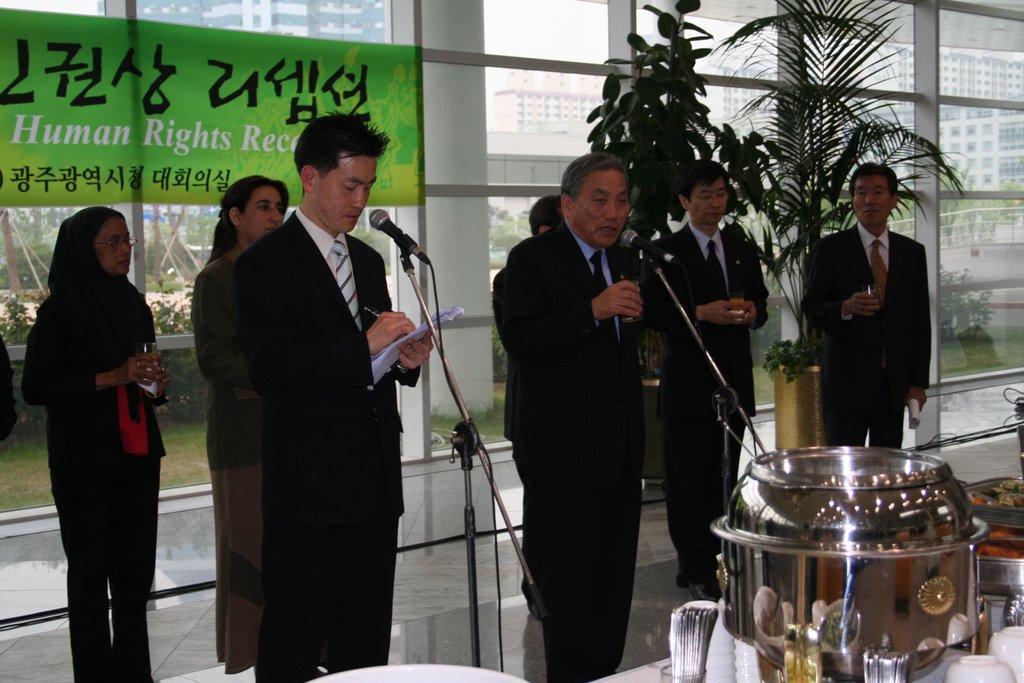
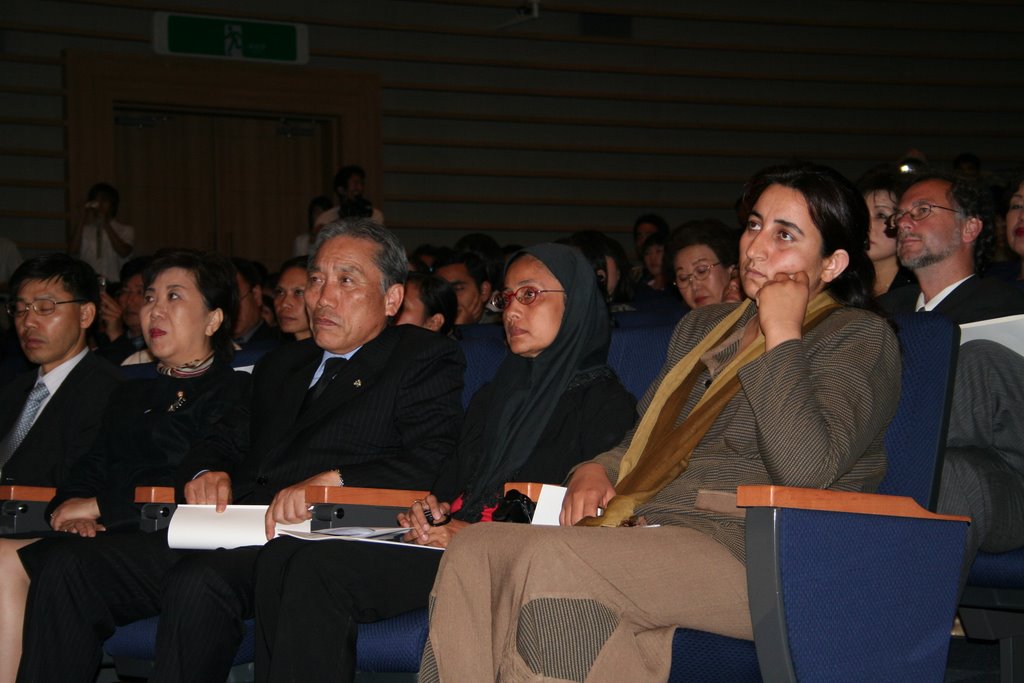

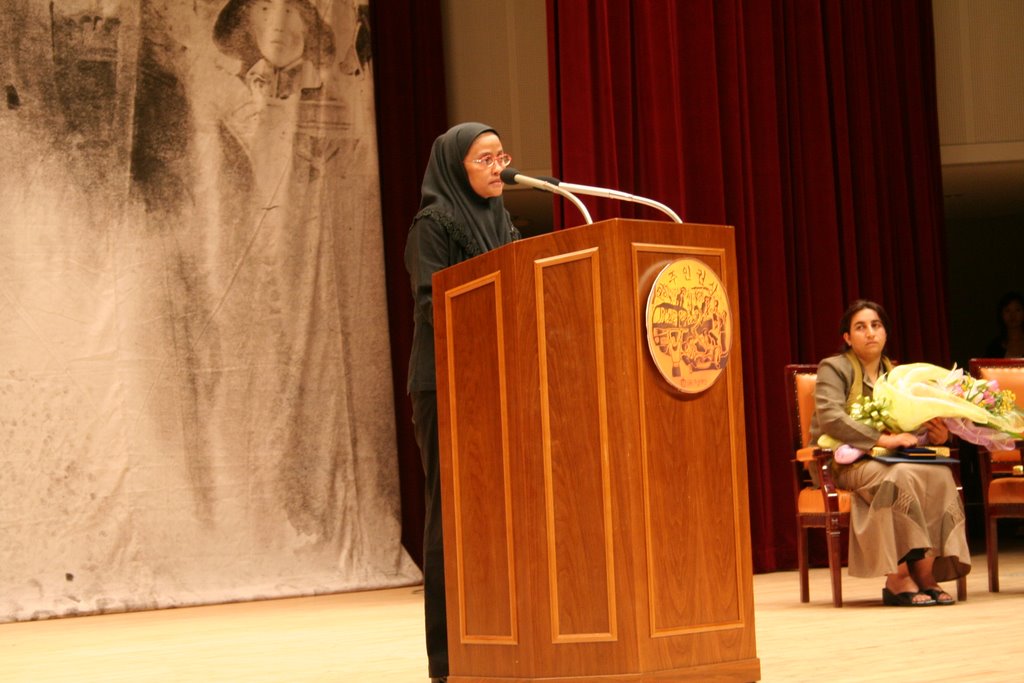


Thursday, May 11, 2006
WOMEN ACTIVISTS TO RECEIVE 2006 GWANGJU HUMAN RIGHTS AWARD

WOMEN ACTIVISTS TO RECEIVE 2006 GWANGJU HUMAN RIGHTS AWARD
Two women activists shall receive this year’s Gwangju Prize for Human Rights. Malalai Joya is a 28-year old Afghan activist and parliamentarian who rose to fame when, as an elected delegate to the Constitutional Loya Jirga, she spoke out publicly against the domination of warlord. Since then she has survived four assassination attempts. Malalai Joya’s work as an activist began at age fourteen in her hometown Farah where she set up an NGO to respond to the needs of women neglected and oppressed under Taliban control. Angkhana Neelaphaijit is the wife of Somchai Neelapajit, a prominent lawyer and human rights defender in Thailand who disappeared in 2004. Since then, Angkhana has been unrelenting in her efforts to obtain justice, unsparing in her criticism of government authorities, and has taken the lead role as an articulate and courageous spokesperson for the families of disappeared persons in Thailand.
Seoul, April 28, 2006 – Two women activists shall receive this year’s Gwangju Prize for Human Rights. They are Malalai Joya from Afghanistan and Angkhana Neelaphaijit from Thailand.
Malalai Joya is a 27 year old Member of the Afghan Parliament. She was elected to the 249-seat National Assembly, or Wolesi Jirga in September 2005, as a representative of Farah Province. Malalai won the second highest number of votes in the province.
Malalai Joya rose to fame in December 2003 when, as an elected delegate to the Constitutional Loya Jirga, she spoke out publicly against the domination of warlords. Since then she has survived four assassination attempts, and travels in Afghanistan under a burqa and with armed guards.
She is the daughter of a former medical student who was wounded while fighting against the Soviet Union (which invaded and occupied Afganistan from 1979 - 1989). Malalai was 4 years old when her family fled Afghanistan in 1982 to the refugee camps of Iran and then Pakistan. She finished her education in Pakistan and began teaching literacy courses to other women at age 19. After the Soviets left, Malalai Joya returned to Afghanistan in 1998 during the Taliban's reign. During that time she established an orphanage and health clinic, and was soon a vocal opponent of the Taliban.
Malalai Joya heads the non-governmental group, "Organisation of Promoting Afghan Women's Capabilities" (OPAWC). She is married to a Kabul-based student of agriculture and has six sisters and three brothers.
Angkhana Neelaphaijit is the wife of Thai human rights lawyer Somchai Neelaphaijit, who was abducted by the police on 12 March 2004. At the time, Somchai was defending clients who had accused the police of torture. His body has never been found. Angkhana has been at the forefront of the campaign to get justice for his disappearance. In January 2006, one police officer was sentenced to three years in jail, but his accomplices and the masterminds of the crime have never been identified. She has received death threats because of her continued work. She has met UN officials both in Thailand and abroad to pursue the case. On International Women's Day 2006 she was given an award by the National Human Rights Commission of Thailand as an "outstanding woman human rights defender". On 11 March 2006 she received the 2nd Asian Human Rights Defender Award of the AHRC on behalf of her husband, which was also given in recognition of her own work since his disappearance two years ago. Angkhana is now an inspiration to large numbers of people in Thailand, as well as internationally. She is supported in her work by her five children.
The Gwangju Prize for Human Rights is an award given to individuals, groups or institutions in Korea and abroad that have contributed in promoting and advancing human rights, democracy and peace in their work. The award is given by the Gwangju people in the spirit of solidarity and gratitude from those whom they have received help in their struggle for democratization and search for truth. Previous winners have included: Xanana Gusmao (2000); : Basil Fernando(2001); Korean Association of bereaved families for democracy (2002): Dandeniya Gamage Jayanthi or Monument for the disappeared·Sri Lanka (2003): Aung San Suu Kyi(2004); and Ms. Wardah Hafidz (2005).
This year’s search received nominees from ten countries. It’s the first time for two winners to share the award. Five of the eight awardees of the Gwangju Prize for Human Rights Award since 2000 were women.
***
For additional information, contact Mr. Chris Kim, Staff Charge for International Solidarity through contact numbers (+82) 010-4642-6650 and (+82)010-800-8052.
The May 18 Memorial Foundation is a non-profit organization established on August 30, 1994. It was organized by surviving victims of the 1980 Gwangju Democratic Uprising, the victims' families, and the citizens of Gwangju. The Foundation aims to commemorate and continue the spirit of struggle and solidarity of the May 18 Uprising, contribute to the peaceful reunification of Korea, and work towards peace and human rights throughout the world. Since its establishment, the Foundation has carried out numerous projects in varying fields, including organizing memorial events, establishing scholarships, fostering research, disseminating public information, publishing relevant materials, dispensing charity and welfare benefits, building international solidarity, and awarding the Gwangju Prize for Human Rights.
The Foundation gets funding from Gwangju citizens, sympathetic overseas Koreans, and from individuals who made sacrifice in the uprising and got indemnification from the government. It is being sustained by people who believe it's important to keep the ideas and memories of the 1980 May 18 Gwangju Democratic Uprising alive and remembered.
Subscribe to:
Posts (Atom)